Home Pro Staff & Celebs Deer Turkey Waterfowl Fishing


DUCKS DOWN THE FLYWAYWaterfowl01

     The sound of mallard wings before first light is unmistakable. And even though it was the first Saturday of December, a woodduck squealed as we put out our decoys. My partner, John Caldwell, and I were hunting a pothole just off the Mississippi River in Clark County near Fenway Landing. December had come in unusually warm, so we had no ice with which to contend. Quite often by this point in the season the northern Missouri duck hunting spots have frozen-up.
     We got our blocks set and retreated to the blind. Max, my black Lab sat patiently at my feet. She was quite appreciative of the warmer conditions as well. With literally dozens of ducks overhead, John and I discussed how these ducks would be gone as soon as cold weather hit and hardened the water. I guaranteed John that when the ducks moved south, so would I. “I’ll chase ‘em all the way to the Boot Heel,” I told him.
     As the sun rose and shooting hours began, we were a bit surprised to have green-winged teal enter the decoys first. As Max retrieved John’s bird we again commented on how warm it was to still have teal around in December. However, the teal were long gone when big mallards began pouring into the pothole.
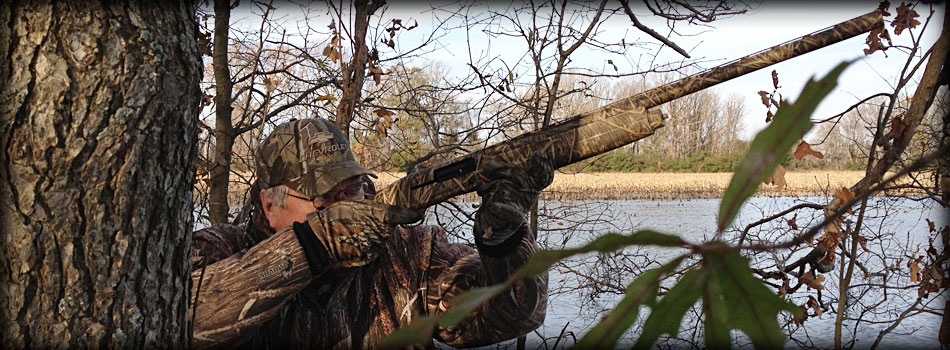
     John’s call rang loud and true as the ducks peeled out of their formation like fighter planes beginning a strafing run. I joined-in with some chatter and soft quacks. On the third circle several birds set their wings and started to glide in. “Wait…wait.” John whispered. “Now!” he yelled.
     A young war ensued and when the shooting was over Max had four mallard drakes to retrieve. We were both proud of our shooting. Four drakes on five shots and no hens. “Good start,” was John’s commentary.
     This type of duck hunting is common in Missouri along the Mississippi River in December. From Iowa to Arkansas, Missouri’s eastern border provides waterfowlers with some of the finest wing-shooting to be found anywhere in the country. No other flyway is so directly associated with a geographic structure as the Mississippi Flyway is to its namesake river. And fortunately for Missouri hunters, the opportunities for quality duck hunting exist all along the Great River.
     Missouri optimizes hunting opportunities for waterfowlers by dividing the state into waterfowl hunting zones. According to Missouri Department of Conservation Waterfowl Biologist Dave Graber, “Missouri is divided into 3 duck management zones. The purpose of the zones is to better tailor hunter preferences for hunting dates.” It seems that hunters in the north zone prefer earlier duck hunting dates than those in the middle and south zones.
     Graber said, “Season preferences are more consistent and predictable in the north, and less so in the south.” He continued by saying, “The lack of consensus among hunters for season dates in the south along the Mississippi is due to unpredictable freeze-up dates, overflow water and different hunting styles. Regardless of the location, hunters who primarily hunt shallow water marshes generally prefer earlier season dates, and hunters who primarily hunt big rivers and reservoirs generally prefer later dates.”
     The preferences that Graber mentions are determined each year by surveying hunters about season dates and periodically they are asked their opinion about zones. Once selected, zones cannot be modified for 5-years. The next time zones can be changed is in 2001.

     The U.S. Fish and Wildlife Service for waterfowl season regulations establish the “frameworks” in early August each year. This is done during the annual regulations setting process where the number of days, bag limit, etc. are determined. Each state must then set their regulations within this framework. Missouri waterfowl regulations are set annually at the August meeting of the Conservation Commission.
     One factor to keep in mind is that all states in the flyway are represented during the framework development. From Minnesota and Michigan to the north, and Louisiana and Alabama to the south, everyone gets to add their two-cents worth to help their hunters get the season dates they prefer.
     The setting of the duck hunting zones in Missouri is also an often-discussed topic. Missouri Department of Conservation Wildlife Research Biologist Dale Humburg says that the U.S. Fish and Wildlife Service established the criteria during 1990-91 to guide selection of duck zones and split seasons. Humburg said, “Zones selected in 1991 had to be retained for 5-years, 1991 to 1995. Only three choices other than a statewide season were available in 1991 and again when zoning was reconsidered in 1996.”
     The options in ’96 were choices between a statewide season split into three segments, two zones with a split season in either or both zones or three zones with continuous seasons in each zone. When Humburg and Dave Graber evaluated the performance of the three-zone plan over the previous 5-years, including duck harvest, distribution of harvest and hunter’s attitudes, they saw no reason to re-align the existing zones. There was no clear-cut desire among hunters to change the zoning regulations, thus the current zones will remain intact through the 2000 hunting season.
     Beginning with the north zone first, let’s look at December duck hunting opportunities along and close to the Mississippi River. In Clark, Lewis and Marion Counties there are many river bottom sloughs and ditches that offer great duck shooting. These areas are not hard to find and are quite often under-hunted. Some of these places are on public ground around river access areas, while others are located on private property. There are very few local duck hunters in this region and getting permission to hunt is seldom difficult.
     Another often-overlooked duck hunting opportunity is the river itself. There are dozens of river access points in these counties and most have concrete boat ramps. Open-water set-ups and floating decoys are a must for river hunting. The best spots to set-up are on sharp channel turns or at the north end of an island.
     When on the river, set your decoys far apart to make them look like a large flock. Also be prepared to call and shoot predominately divers. You will see and work some puddle ducks, but divers are the most likely to sit-down in the river’s current.Waterfowl02
     For impoundment hunting Mark Twain Lake in Marion and Ralls Counties is far above average for a December duck lake. Because it is over 18,000-acres in size, this lake normally will not freeze-up in early December. Deep-water decoy rigs are needed as is a boat blind. The main lake has plenty of room for lots of hunters but I recommend the timbered points of Indian Creek to attract the mallards that will be coming through this time of year.
     A new spot for N.E. Missouri duck hunters to try-out this season is Henry Sever Lake in Knox County. This impoundment has not allowed duck hunting in the past. Both ducks and geese have used this lake heavily for the past couple years. This recent surge in waterfowl numbers has prompted the Department of Conservation to open this lake for hunting in 1999.
     As we move on down the river to Lincoln and St. Charles Counties, the public access duck hunting spots are now complimented by dozens of private ducks clubs. Even though these clubs are privately owned, many offer daily hunts to non-members.
     South of St. Louis, Jefferson, St. Genevieve, St. Francios and Washington Counties give December duck hunters many options. Not only does the Mississippi itself still present good duck hunting, but many public reservoirs also give hunters chances to score on late migrating ducks. Most of these are Department of Conservation managed areas.
     In Washington County, Council Bluffs Lake is a good bet. This is a very deep lake so long decoy lines are required. Even though this is not a huge lake, open water decoy spreads and high-pitched, ringing calls will work best. Lots of divers use this water in December, therefore mixing some bluebill or canvasback decoys into your spread is recommended.
     Bismark Lake in St. Francios County is another good choice for the December migration. This lake is virtually covered-up with woodducks and wigeon in the early season. This time of year mallards, gadwall and an occasional flock of divers frequent this lake. On Bismark Lake, Council Bluffs and all other D.O.C. waters, permanent blinds are not allowed. Blinds and decoys must be removed each night.
     It is interesting that mallards tend to dominate the December duck harvest numbers in Missouri, regardless of the zone. Dave Graber said, “About 80% of the harvest in December is comprised of mallards. This compares to about 24% during the last week of October. Gadwalls, green-winged teal, pintails and shovelers show-up in the harvest during December in mild years as well.”
     On the average, 95% of the mallard use occurs by mid-December along the Mississippi River in the St. Charles area. Mallard use of the lower Mississippi River area is sustained later because of a pattern of late-season rainfall, which enhances habitat conditions along rivers in the southeast part of the Show-Me State.
     Now that the Boot Heel section has been mentioned, let’s discuss some of the hot spots for December duck hunts down south. Southeast Missouri is literally rich with excellent late-season locations to collect a limit of ducks. The large majority of these spots are Conservation areas and some of them even have blinds that are available for public use though a drawing system that we will cover later.
     The most well known of the southeastern Conservation areas is Duck Creek CA. Flooded timber potholes are the order of the day at Duck Creek. Mallards pour into this area in large clouds in the late-season. Roger Lewis of Park Hills and I have had some of our best hunts here on flight days when tired mallards were fighting each other to get into our decoys.
The D.O.C. furnishes boats for your use at Duck Creek, but you need to bring a motor. Some of the blinds are several hundred yards from the boat launch, so I do recommend a gas motor. There is also a designated “wade-and-shoot” area inside Duck Creek CA where all you need is your gun and your waders.

     Duck Creek CA once again employs a reservation system that was abolished for a few years in the recent past. This reservation system was used from 1947 to 1997 to allocate much of the hunting for waterfowl on D.O.C. wetland areas. During the drought period of the 1980’s when duck numbers fell, this system was gradually eliminated. Because of the increase in duck numbers in 1997 and 1998, the demand for hunting opportunities far outweighed supply.
     For the 1999-2000 duck season, the reservation system that was re-instituted last year in the Department’s heavily managed wetland areas will once again be used. The official recommendation from the Missouri Department of Conservation reads as follows: Re-institute a reservation system in 1998 to equitably allocate 50% of the available hunting opportunity on intensively managed wetland areas that conduct daily drawings.
     Other prime duck hunting Conservation Areas in the southeast do not hold daily drawing or have a reservation system. Dark Cypress Swamp CA is a good example. The flooded-timber potholes that dot this area are perfect places for the portable duck hunter. Dark Cypress almost always fills-up with Canadian mallards in late December, barring a freeze-up. The very best places in this CA are the wade-and-shoot areas. Lots of mallards use these spots and the hunting pressure is minimal.
     Otter Slough CA is another 5,000-acres of flooded timber and fields. There are some blinds on this CA that are given in daily drawings. On flight days this area can see huge flocks of all puddle duck species arrive from the north. In addition to the blinds, pothole hunting and a wade-and-shoot area are also available.
     Dale Humburg told me that this southeastern region produces such outstanding late-season duck hunting because the northern areas usually freeze-up by mid to late December. “An early season freeze-up in the north sends lots of ducks to this area. Even though massive cold fronts produce days of high migration, week-long, steady cold temperatures in Iowa and northern Missouri push a lot of ducks our way, too."
     One of the main problems associated with duck hunting along Missouri’s lower Mississippi region is the huge amount of sheet-water that the puddle ducks use there. Sheet-water is defined as flooded areas of usually dry ground that is holding water less than 6-inches deep.
     As you can imagine, sheet-water conditions are perfect for tired, hungry migrating ducks. The drawback is that it does not take bitterly cold temperatures to freeze these spots over. Hunters who like the flooded field conditions want milder temperatures. Duck hunters who hunt open or deeper water actually want colder weather to freeze the sheet-water, forcing the migrating mallards to their open water set-ups.Waterfowl03
     One of the hottest duck hunts I have ever experienced occurred over sheet-water in New Madrid County in the Boot Heel. Heavy fall rains had caused small creeks and rivers to flood in late November. Many of the big farms in S.E. Missouri had not been able to get their crops out because of muddy, soggy field conditions. Many of these fields still had water standing in them.
     I found one such field of unharvested soybeans and was given permission to hunt ducks there. The day I got permission I saw at least a thousand mallard using the field. I got in the next morning and put out only about 20 decoys. The water was just deep enough to float the blocks and put swimming ducks right in the middle of the plump beans. It was a sweet set-up.
It was well before dawn when the first ducks arrived. These ducks had obviously rested elsewhere overnight and intended to come here to feed. I knew most of them were mallards, but I also expected some gadwall and black ducks. The mallards got there first and there were lots of them.
     I had let several dozen ducks sit-down in the decoys before legal shooting hours. As the moment of truth arrived, there were hundreds of ducks in the air. The quacking and chattering was incredible. I almost decided not to shoot. Almost. Four huge mallard drakes set their wings and glided over my spread from right to left. I raised my gun and splashed the first and fourth birds.
     The sight of all the ducks in the field getting up at one time was astonishing. I could have easily had a dozen more shots. But this time I did choose to just watch. I knew ducks would be coming and going here all day. I was in no hurry. By the time I finished my limit I had seen thousands of ducks and had worked literally hundreds.
     For more information on duck hunting along the Mississippi River in Missouri call the Department of Conservation at 573-751-4115.


MROE Logo

2004
IL Outdoor Writer
of the Year!

PO Box 711
Quincy, IL  62306-0711
(217) 257-7895